The new aquaponics training program at the University of Montpellier has just been inaugurated
On Wednesday, July 5, 2023, the University of Montpellier inaugurated the new aquaponics training facility at the Mediterranean Coastal Environment Station in Sète, in the presence of Philippe Augé, President of the University of Montpellier; Éric Servat, Director of the Montpellier Environmental Research Observatory (OSU OREME); Laurence Weil, Director of the Continuing Education Department (SFC UM), and François Pierrot, Deputy Director of the Committee for Strategic and Structural Investments.
Aquaculture is a sector growing at a rate of 5 to 10 percent per year worldwide, with an annual output of approximately 125 million metric tons. For several years now, aquaculture production has exceeded wild-caught fish production. This booming sector aims to reach 200 million metric tons per year by 2030 and currently employs 70 million people. To provide training and help professionals in this industry develop their skills, the University of Montpellier is opening a training program in aquaponics.
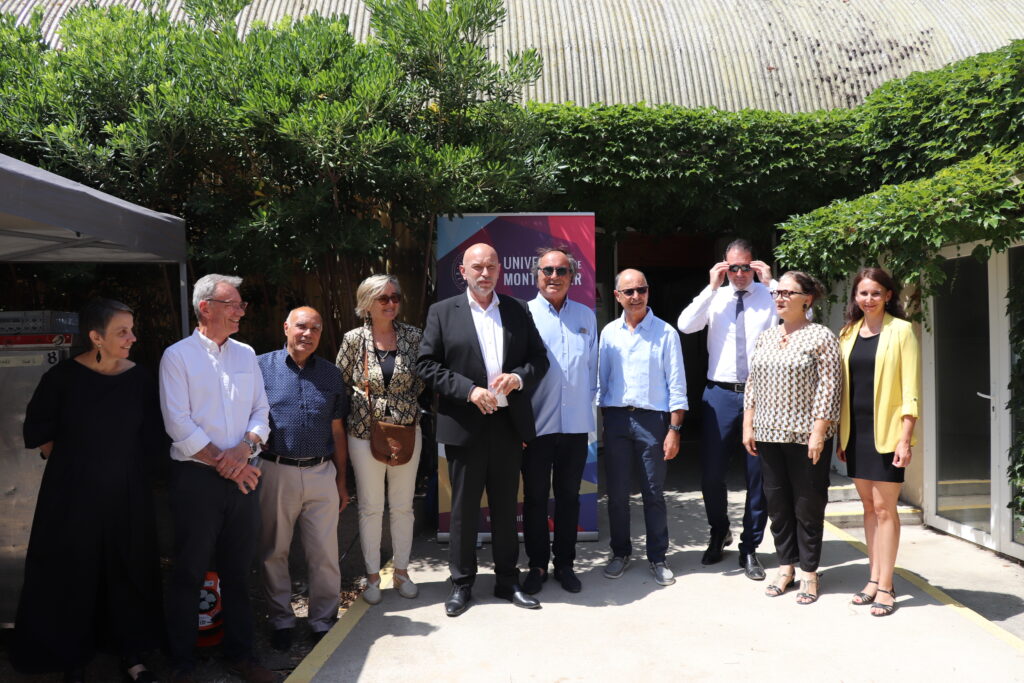
From left to right: Agnès Fichard Caroll, Eric Servat, Mattéo Valenza, Laurence Magne, Philippe Augé, François Commeinhes, Claude Amiel, Guillaume Raymond, Laurence Weil, Céline Ritterszki.
“This Wednesday, François Commeinhes and I officially opened the SMEL Sète aquaponics training unit at the University of Montpellier. “This facility is supported by our university’s I-SITE program of excellence and will enable continuing education students to learn the practical skills of aquaponics, aquaculture, and fish farming ,” said Philippe Augé, President of the University of Montpellier.
Meeting Market Needs
The professional training program in aquaculture offered by the University of Montpellier’s Continuing Education Department (SFC-UM), based at the Mediterranean Coastal Environment Station (SMEL) in Sète, covers planning, operations, and development activities related to living aquatic resources and the management of their environment (aquaculture, aquaponics, recreation and aquaculture, public aquariums, etc.).
The foundation for the development of this training program is to meet market needs, leverage knowledge derived from research, draw on the expertise of researchers and our transnational professional network, provide multidisciplinary and interdisciplinary skills, and apply them throughout the training programs. This comprehensive approach was designed within the regional ecosystem, which brings together research and higher education institutions specializing in Mediterranean and tropical agricultural development (OSU OREME, IFREMER, IRD, CIRAD, CNRS, IRSTEA, INRAE, etc.).
A training program with clearly defined objectives
The University of Montpellier aims to expand this educational program and has set the following objectives:
- The transition of part of the training program to a hybrid system combining e-learning and in-person instruction,
- The creation of innovative pilot production units to provide hands-on experience for students at SMEL,
- The creation of new degree and certificate programs,
- Engage closely with vocational training institutions, R&D organizations, and its professional network to facilitate the transfer of skills,
- To foster and strengthen our professional network in order to build connections among former students, the professional community, and current students, and to make our vocational training program more visible and accessible.
Through the MUSE Take Off 3 and 4 programs, the University of Montpellier’s continuing education department is developing new training tools, including:
- An aquaponics production facility: an integrated system combining high-value-added plant and animal production in a recirculating water system. Products include vegetable crops, medicinal plants, aromatic plants, and other aquatic organisms for food or ornamental purposes. The strengths of this system include water savings, biosecurity, the ability to set up above-ground facilities—and thus close to markets—the creation of microenterprises, and improved performance.
- A biofloc production unit: used to produce edible or ornamental aquatic organisms within a consortium of aquatic microorganisms—such as bacteria, phytoplankton, and zooplankton—to enable self-purification of the water. The strengths of this system are the same as those of the previous one.
- A production facility for ornamental marine organisms using a recirculating aquaculture system. The strengths of this system are the same as those of the other two production facilities, with the added benefit of better protection of wild fish stocks.
Practical Information
Inauguration Date: July 5, 2023
Location: Sète Mediterranean Coastal Environment Station, 2 rue des chantiers, 34200, Sète https://sfc.edu.umontpellier.fr/formations/aquaculture/
Press contact
, University of Montpellier
Nathan Roure
nathan.roure@umontpellier.fr
Contact
, SFC—University of Montpellier
Céline Ritterszki
dir-sfc@umontpellier.fr